

Hiring a maid in Singapore involves more than choosing a suitable helper and applying for her Work Permit.
Before she starts working in your home, both employer and helper should have a clear understanding of the employment arrangement.
This is where the maid employment contract becomes important.
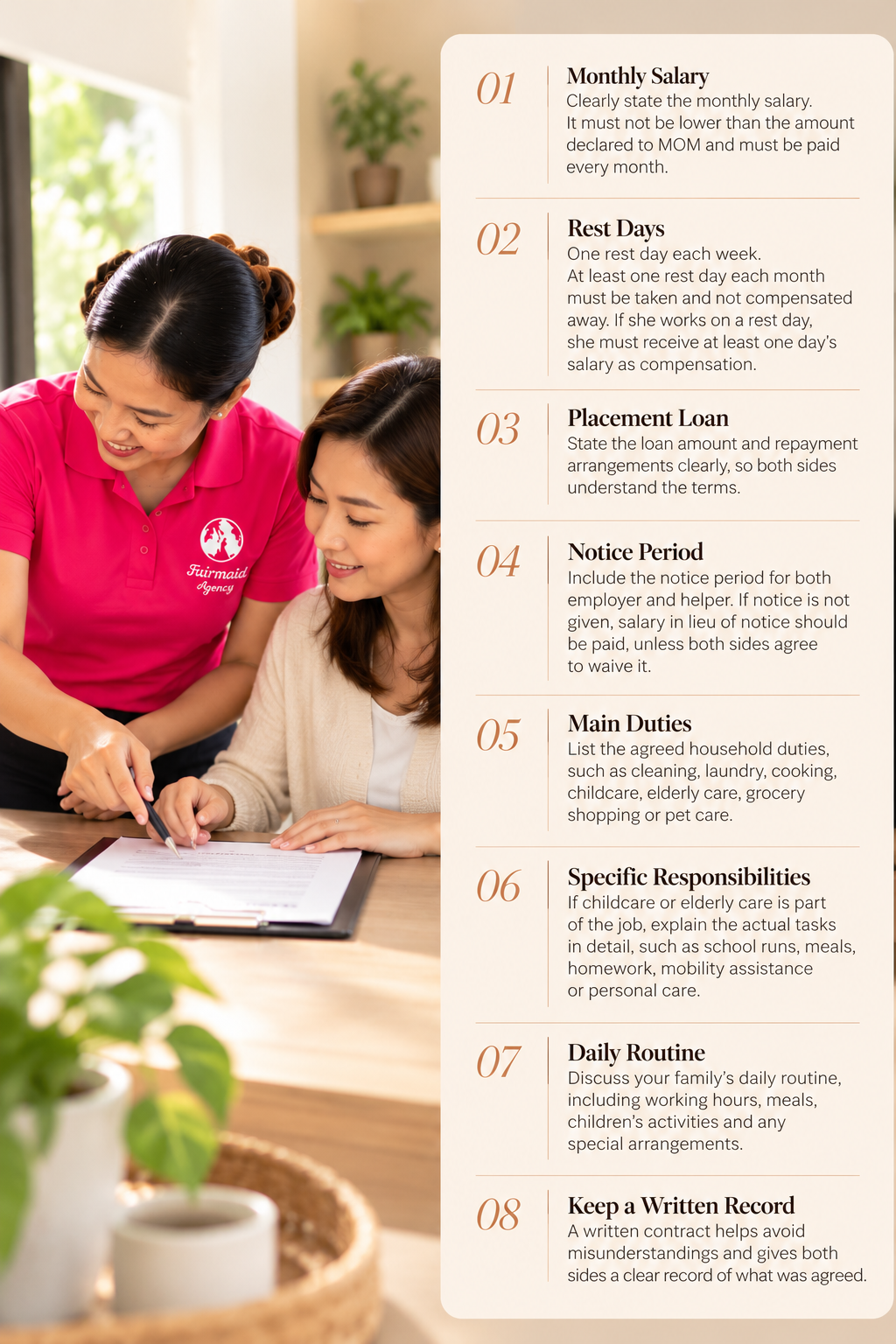
A written contract gives both sides a clear record of what was agreed. It helps avoid misunderstandings about salary, rest days, duties and what happens if either side needs to end the employment arrangement early.
MOM encourages employers to sign an employment contract with their migrant domestic worker and recommends including key terms such as salary, placement loan, rest days, compensation in lieu of rest days, notice period and compensation in lieu of notice.
What Is a Maid Employment Contract?
A maid employment contract is an agreement between the employer and the migrant domestic worker that sets out the terms and conditions of employment.
Unlike most employees covered by the Employment Act, migrant domestic workers are not covered by the Employment Act because domestic work has different requirements. MOM therefore encourages employers to put the agreed employment terms in writing to reduce the possibility of disputes.
Fairmaid Agency can also help prepare the employment contract for you and your helper.
What Should Be Included in a Maid Contract?
The contract should clearly set out the terms both sides have agreed to.
Important areas include:
• Monthly salary
• Placement loan arrangements
• Rest days
• Compensation if a rest day is worked
• Notice period
• Salary in lieu of notice
• Main household duties
• Other agreed responsibilities
The more specific the agreement, the easier it is for both sides to understand what the job involves.
Salary
Your helper's monthly salary should be clearly stated in the contract.
You must pay her every month and the salary must not be lower than the amount declared to MOM. The salary period cannot exceed one month, and payment must be made no later than seven days after the end of the salary period.
If you pay by cash, keep proper records of the payments. If your helper requests payment by bank transfer, you must pay her through direct bank transfer.
Employers should also remember that they are not allowed to keep their helper's salary, bank book or bank card.
Rest Days
Rest days should be discussed before employment starts and clearly recorded in the contract.
A migrant domestic worker is entitled to one rest day each week. The employer and helper should mutually agree on which day the rest day will be taken. If she agrees to work on a rest day, she must receive at least one day's salary as compensation.
There is also a mandatory requirement for at least one rest day each month to be taken and not compensated away.
Families sometimes have specific schedules because of young children, elderly parents or weekend commitments.
Discuss the arrangement openly with your helper rather than making assumptions about when her rest days will be.
Placement Loan
If your helper has a placement loan arrangement, the contract should state the agreed terms.
Make sure both sides understand the amount involved and how repayment works.
This is particularly important for first-time employers who might not be familiar with the different costs involved when hiring a domestic helper.
Notice Period
Your contract should state the notice period required if either party wants to end the employment arrangement.
Both the employer and the helper have the right to terminate the employment contract by giving the notice stated in the contract. If the required notice is not given, salary in lieu of notice should be paid. The notice period can also be waived if both sides agree.
This gives both sides flexibility if circumstances change.
For example, a family might experience a change in caregiving needs, or a helper might decide she is unable to continue with the employment arrangement.
What About the Maid's Duties?
Your contract should give a clear picture of the work involved.
Household duties might include:
• Cleaning
• Laundry and ironing
• Cooking
• Grocery shopping
• Looking after children
• Caring for elderly family members
• Looking after household pets
• Other domestic responsibilities agreed between the employer and helper
If childcare or elderly care is a major part of the job, explain the responsibilities clearly.
For example, “childcare” is broad. Your helper might be expected to prepare meals, bring children to school, supervise homework and accompany them to enrichment classes.
Likewise, “elderly care” could mean companionship and meal preparation for an independent elderly parent, or it could involve mobility assistance and personal care.
Be specific about the actual role.
Discuss the Daily Routine
The contract sets out the agreed employment terms, but a conversation about the household routine is equally important.
Explain what a normal day looks like.
If your children need to leave for school early, tell her.
If your elderly parent needs help getting ready in the morning, explain it.
If the family eats dinner late or has regular weekend activities, discuss the routine.
Clear communication at the beginning gives your helper a realistic understanding of the job.
Salary Deductions
Employers should also understand the rules around salary deductions.
Do not treat deductions as a way to recover general employment costs.
MOM states that employers of migrant workers are not allowed to deduct salary for costs such as Work Permit renewal, security bond, medical insurance, repatriation costs, compulsory training, medical fees or levy payments.
If you are unsure whether a particular deduction is permitted, check the current MOM requirements before making the deduction.
Safety Agreement
The employment contract is separate from the safety agreement.
When you hire a migrant domestic worker, your employment agency must arrange for the employer and helper to sign a safety agreement. The agreement covers restrictions and safety requirements relating to cleaning the exterior of windows.
For a first-time MDW, the safety agreement is signed after she attends the Settling-In Programme and before she starts work at your home. For other MDWs, it should be signed before deployment.
Both the employer and helper should keep a copy.
What Happens If the Contract Ends Early?
A two-year contract does not mean either side has to remain in the employment arrangement until the exact end date regardless of circumstances.
MOM states that both the employer and MDW can terminate the contract early as long as the required notice is served or payment is made in lieu of notice.
If employment ends, the employer also needs to complete the relevant Work Permit cancellation and other arrangements for the helper's departure or transfer.
Fairmaid Agency can guide you through the process.
Why a Clear Contract Helps Both Sides
A maid employment contract is useful because it puts the important terms in writing.
It gives the employer a clear record of what was agreed.
It also gives the helper a clear understanding of her salary, rest days, responsibilities and notice arrangements.
Many employment problems start when expectations were never discussed properly at the beginning.
If the family expects the helper to look after two young children, cook daily meals and care for an elderly parent, these responsibilities should be explained before employment starts.
The same applies to rest days, salary and other arrangements.
A clear agreement gives both sides something to refer back to.
How Fairmaid agency Helps With the Hiring Process
At Fairmaid Agency, we understand that hiring a domestic helper involves more than matching a family with a candidate.
The employment arrangement needs to be clear from the beginning.
We help families understand the hiring process, discuss household requirements and prepare the necessary employment arrangements with their selected helper.
If you are hiring a maid for the first time, it is worth discussing your expectations before the helper arrives.
Explain your family structure, daily routine, household duties and any childcare or elderly-care responsibilities.
The better both sides understand the arrangement at the beginning, the easier it is to build a good working relationship.
If you are looking to hire a maid in Singapore and want guidance on the employment process, speak to Fairmaid Agency about your family's requirements.
Frequently Asked Questions
Is an employment contract required for a maid in Singapore?
MOM encourages employers to sign an employment contract with their migrant domestic worker to avoid disputes. The agreed terms should cover areas such as salary, placement loan, rest days, compensation for rest days, notice period and compensation in lieu of notice.
Are maids covered by the Employment Act in Singapore?
Migrant domestic workers are not covered by the Employment Act. Their employment and well-being are governed under the Employment of Foreign Manpower Act and related MOM requirements.
How many rest days does a maid get in Singapore?
A migrant domestic worker is entitled to one rest day each week. At least one rest day each month must be taken and cannot be compensated away. If she agrees to work on other rest days, she must receive at least one day's salary for each rest day worked.
What should be included in a maid contract?
The contract should cover agreed terms such as salary, placement loan, rest days, compensation in lieu of rest days, notice period and compensation in lieu of termination notice. It is also useful to clearly describe the main household responsibilities.
Can an employer terminate a maid's contract early?
Yes. Either the employer or the migrant domestic worker can terminate the employment contract early by serving the notice period stated in the contract or paying salary in lieu of notice.
Can an employer deduct the maid's salary for the levy or insurance?
No. Employers are not allowed to deduct salary for employment-related costs such as the levy, Work Permit renewal, security bond, medical insurance, repatriation costs, compulsory training or medical fees.
Should I use an employment agency to prepare the maid contract?
Your employment agency can help draft the employment contract for you and your helper. This is useful for first-time employers who want to make sure the agreed employment terms are clearly recorded.